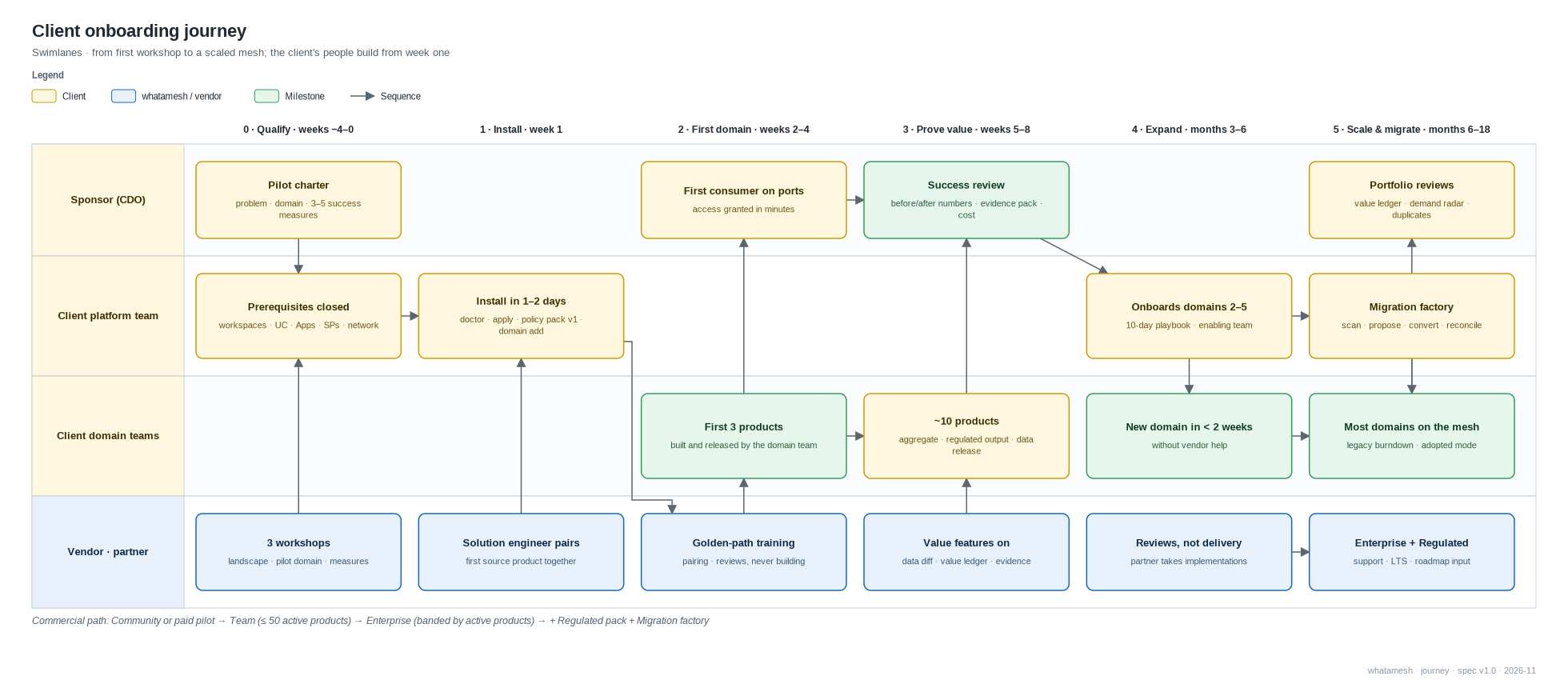
1. The journey at a glance
| Stage | When | Goal | Exit criterion | Commercial step |
|---|---|---|---|---|
| 0 · Qualify | Weeks −4 to 0 | Agree the problem, the pilot domain and success measures | Signed pilot scope | Community (free) or paid pilot |
| 1 · Install | Week 1 | Platform running in the client tenant | wam platform doctor green; marketplace reachable | Pilot |
| 2 · First domain | Weeks 2–4 | One domain builds its first products itself | 3 products in prod, built by the domain team | Pilot |
| 3 · Prove value | Weeks 5–8 | 10 products, governance and consumers working | Pilot success review passed | Pilot → Team or Enterprise |
| 4 · Expand | Months 3–6 | 3–5 domains; the platform team runs onboarding without us | New domain live in < 2 weeks without vendor help | Team → Enterprise |
| 5 · Scale and migrate | Months 6–18 | Most domains on the mesh; legacy estate shrinking | Migration burndown on track; regulated chain on data releases | Enterprise + Regulated pack + Migration |
The rule behind the plan: the client's people build from the first week. Vendor and partner engineers pair and teach; they do not build products for the client. A pilot that we build alone proves nothing about self-serve.
2. Who is involved
| Role | Client or vendor | Time in the pilot | Responsibility |
|---|---|---|---|
| Executive sponsor (CDO or head of data) | Client | 1 h every two weeks | Sets success measures, removes blockers, decides on expansion |
| Platform lead | Client | 50% | Owns the installation and the platform afterwards |
| Platform engineers (1–2) | Client | 50–100% | Install, connect sources, operate |
| Pilot domain owner | Client | 10–20% | Chooses products, approves releases and access |
| Domain developers (2–4) | Client | 50% | Build the products |
| Data steward | Client | 10–20% | Policy pack, classification, glossary terms |
| Security and network contact | Client | On call in weeks −2 to 1 | Private Link, firewall, service principals, approvals |
| Onboarding lead | Vendor | 50% | Runs the plan, weekly check-ins, success review |
| Solution engineer | Vendor or partner | 100% in weeks 1–4, then 50% | Installation, pairing, first products |
3. Stage 0 · Qualify (weeks −4 to 0)
Workshops (three half-days, on site or remote):
- Landscape: sources, existing Databricks setup, landing zone, Git provider, identity, current pain (bottlenecks, shadow IT, regulatory reporting).
- Pilot domain choice: pick a domain that is consumption-heavy, has a motivated owner and SQL-fluent people, and needs 2–4 sources. Finance or actuarial is often a good fit.
- Success measures: agree three to five numbers, measured before and after, for example:
- lead time from idea to a production product (today: weeks; target: < 1 day for P3)
- time to grant access (today: days; target: < 1 business day)
- share of products built by the domain team itself (target: 100% in the pilot)
- one regulated or business-critical output rebuilt as products with lineage and evidence
Prerequisites checklist (sent after workshop 1; the client's platform team completes it before week 1):
- Azure Databricks Premium workspaces for dev, test and prod (or approval to create them), Unity Catalog enabled, serverless enabled
- Permission to create catalogs (or pre-created
dp_<domain>_<env>catalogs) - Databricks Apps and Lakebase enabled in the prod workspace
- Entra ID: groups can be created or synced via SCIM; an app registration for CI with OIDC federation
- Service principals: one platform SP, one per pilot domain per environment
- Network: private endpoints and firewall rules for the source databases; egress rules for the Git provider
- Git provider organisation or project where repos can be created; CI runners (hosted or self-hosted)
- Read access to 2–4 pilot sources (CT or CDC enabled on SQL Server where needed)
- Access to AI Gateway / Model Serving if AI drafting is in scope
- Security review of the free CLI started (signed releases and SBOM are provided; source review under NDA on request)
Output: pilot charter (scope, people, measures, dates), signed pilot order or Community start.
4. Stage 1 · Install (week 1)
| Day | What happens | Commands / artefacts | Done when |
|---|---|---|---|
| Mon | Kick-off; walk through the prerequisites list; fix gaps | — | All blockers have an owner and a date |
| Mon | Platform check | uv tool install whatamesh · wam platform init · wam platform doctor | Doctor green, or a list of exact fixes |
| Tue | Install the platform (plan first, then apply) | wam platform plan · wam platform apply | Platform catalog, ops tables, release volume, App 1, App 2, Lakebase, platform jobs deployed |
| Tue | Policy pack v1: start from the template, set naming, tiers, classification vocabulary | [email protected] repo | Pack published, pinned by the platform |
| Wed | Onboard the pilot domain | wam domain add finance --owners … --developers … | Catalogs, groups, SPs, repo from template, CI variables, budget |
| Wed | Connect the first source | wam source register lifepro --connector mssql-ct · wam source test | Source tables listed in the marketplace as candidates |
| Thu | First source-aligned product, built by the platform engineer with the solution engineer | wam add source wizard → PR | Product in prod via gates 1–4 |
| Fri | Show and tell to the domain team; hand-over of the golden path | Marketplace tour, Studio tour | Domain developers have access and can run wam validate |
Typical time to a working platform: one to two days in a bring-your-own landing zone. Most of week 1 is spent on network and permission tickets, which is why the prerequisites list comes first.
5. Stage 2 · First domain (weeks 2–4)
Week 2 — learn by building. A two-hour hands-on session, then pairing:
- Each developer builds one product end to end:
wam new product→ SQL →wam validate→wam preview→ PR → approval → prod. - If AI drafting is in scope, one product starts as
wam ai draftand is reviewed like any PR. - The steward classifies source columns (with AI suggestions) and binds the first glossary terms.
Week 3 — consumers. The first consumer (a Power BI report or Genie space) moves onto the products:
- The consumer requests access in the marketplace; the owner approves; the grant is automatic and expires.
- The report reads through the published port; the PR for the next change shows the data diff and the KPI impact.
Week 4 — operate. The domain runs its products on its own:
- An incident is simulated (a source loads late); alert grouping and the incident timeline are reviewed.
- The domain owner reviews the Trust Scores and fixes the red badges.
Exit: at least 3 products in prod, built and released by the domain team; one consumer reading through ports; one access request handled end to end.
6. Stage 3 · Prove value (weeks 5–8)
- Grow to about 10 products, including at least one aggregate (for example a policy master) and one consumer-aligned product behind a regulated or board-level output.
- Turn on the value features that matter for the decision:
- data releases for one reporting chain (month-end close run in parallel with the old process)
- evidence pack for that output, reviewed by the compliance contact
- value ledger first view for the pilot domain
- Week 8 · success review with the sponsor: the before/after numbers from stage 0, a demo by the domain team (not by the vendor), the cost of the pilot in Databricks spend, and the expansion plan.
Exit: success measures met or explained; decision on Team or Enterprise; next 2–4 domains named.
7. Stage 4 · Expand (months 3–6)
- The client's platform team onboards domains 2–5 using a domain onboarding playbook (below); the vendor reviews instead of doing the work.
- An enabling team forms on the client side (2–3 people from the pilot) that coaches new domains for their first two weeks.
- The policy pack goes to v1.0 with the governance group; waivers from the pilot are reviewed.
- Catalog sync (Collibra or Purview) and FinOps budgets per domain are switched on.
Domain onboarding playbook (10 working days):
| Day | Step |
|---|---|
| 1 | Domain intake: owner, developers, sources, first three products, consumers |
| 1 | wam domain add · groups and repo created |
| 2 | Source registration and test (if new sources are needed) |
| 3 | Two-hour golden-path session for the new team |
| 3–8 | First three products built with an enabling-team coach |
| 9 | First consumer moved onto a port; access via marketplace |
| 10 | Review: Trust Scores, open waivers, next products |
Exit: a new domain is live in under two weeks without vendor involvement.
8. Stage 5 · Scale and migrate (months 6–18)
- Migration factory on the legacy estate, always starting with a paid discovery (2–4 weeks) that produces the object inventory, complexity scores and a wave plan; each wave is then priced on a known batch of objects and delivered by a certified partner, with the vendor providing the factory licence and reconciliation expertise (see
BUSINESS_MODEL.md§6).wam migrate scanbuilds the inventory and lineage;proposesuggests product boundaries and flags duplicate metrics; domains convert and reconcile in waves; legacy objects are switched off when reconciled. - Adopted mode brings the existing Databricks medallion tables under contracts and the marketplace first, refactoring later.
- Regulated chains move to data releases, with evidence packs on demand.
- Mesh intelligence runs across domains: demand radar, duplicate detection, portfolio reviews each quarter.
- The commercial step is usually Enterprise with the Regulated pack and a migration factory licence.
9. What the client sees, week by week
| Week | The sponsor sees | The domain team sees | The platform team sees |
|---|---|---|---|
| 0 | Pilot charter with measures | Invitation to the kick-off | Prerequisites checklist |
| 1 | Marketplace running in their tenant | First source tables in the marketplace | Doctor green, platform deployed |
| 2 | First products built by their own people | Golden path; first PRs with rule feedback | CI running gates |
| 3 | A report reading governed ports; access granted in minutes | Data diff on PRs; consumers asking for access | Grants created automatically |
| 4 | Trust Scores per product | Incidents grouped with root cause | Nothing to do by hand |
| 8 | Before/after numbers; evidence pack; cost of the pilot | Their demo to the sponsor | Domain onboarding playbook drafted |
10. Risks during onboarding and how we handle them
| Risk | Early signal | Response |
|---|---|---|
| Network and permission tickets stall week 1 | Prerequisites list incomplete at week −1 | Move the start date; never start a pilot without the list closed |
| The domain team is too busy | Developers miss the week-2 sessions | Sponsor intervention; reduce scope to 2 developers who are protected |
| The vendor ends up building | Most PRs authored by vendor engineers | Hard rule: vendor engineers pair, client engineers commit |
| The policy pack becomes a debate | Pack not published by day 2 | Start from the template; change by PR later; waivers for edge cases |
| Success measures are vague | No baseline numbers by week 1 | Take the baseline in week 1 from tickets and system tables |
| Pilot domain has no real consumer | No report moves onto ports by week 4 | Pick a different consumer or a different domain before week 5 |
| Scope creeps into migration | Sponsor asks to "just move" legacy jobs during the pilot | Keep the pilot to 5–10 new products; log the request as input to a migration discovery |
11. Handover artefacts
At the end of the pilot the client keeps: the platform installation as code, the policy pack repo, the domain repos and products, the domain onboarding playbook, recorded training sessions, the success review deck, and a named contact for support. Everything runs in their tenant and Git; nothing depends on vendor infrastructure.