Follow the data behind lapse_risk, the monthly probability that a policy lapses. Scroll, and the same rows move one step further in every chapter. Skip the story ↓
1 / 9 · raw sources
It starts as a mess
Premiums in LifePRO, policies in the admin system, lapse flags in a spreadsheet on a share. A duplicate, three date formats, gaps, and national IDs in plain sight. Four teams rebuild the same join every night.
What whatamesh does here
wam assess estate scan
Ownership, PII and duplicate gaps
Business case in your numbers
2 / 9 · bronze → silver
Cleaned on the way in
Ingestion lands each source in bronze. Silver drops the duplicate, settles one date format and one vocabulary, and marks missing values as null so nobody has to guess them.
What whatamesh does here
Lakeflow Connect and Debezium CDC
Auto Loader for files
Generated bronze and silver
Dedupe and standardise rules
3 / 9 · gold
Joined into one answer
Gold joins the three into what the business actually asks: how likely each policy is to lapse this month. That SQL is the only part the team writes.
Generated for you: DDL and incremental MERGE · a Lakeflow job on input triggers · a bundle per environment · grants and masks from tags · checks for the tier.
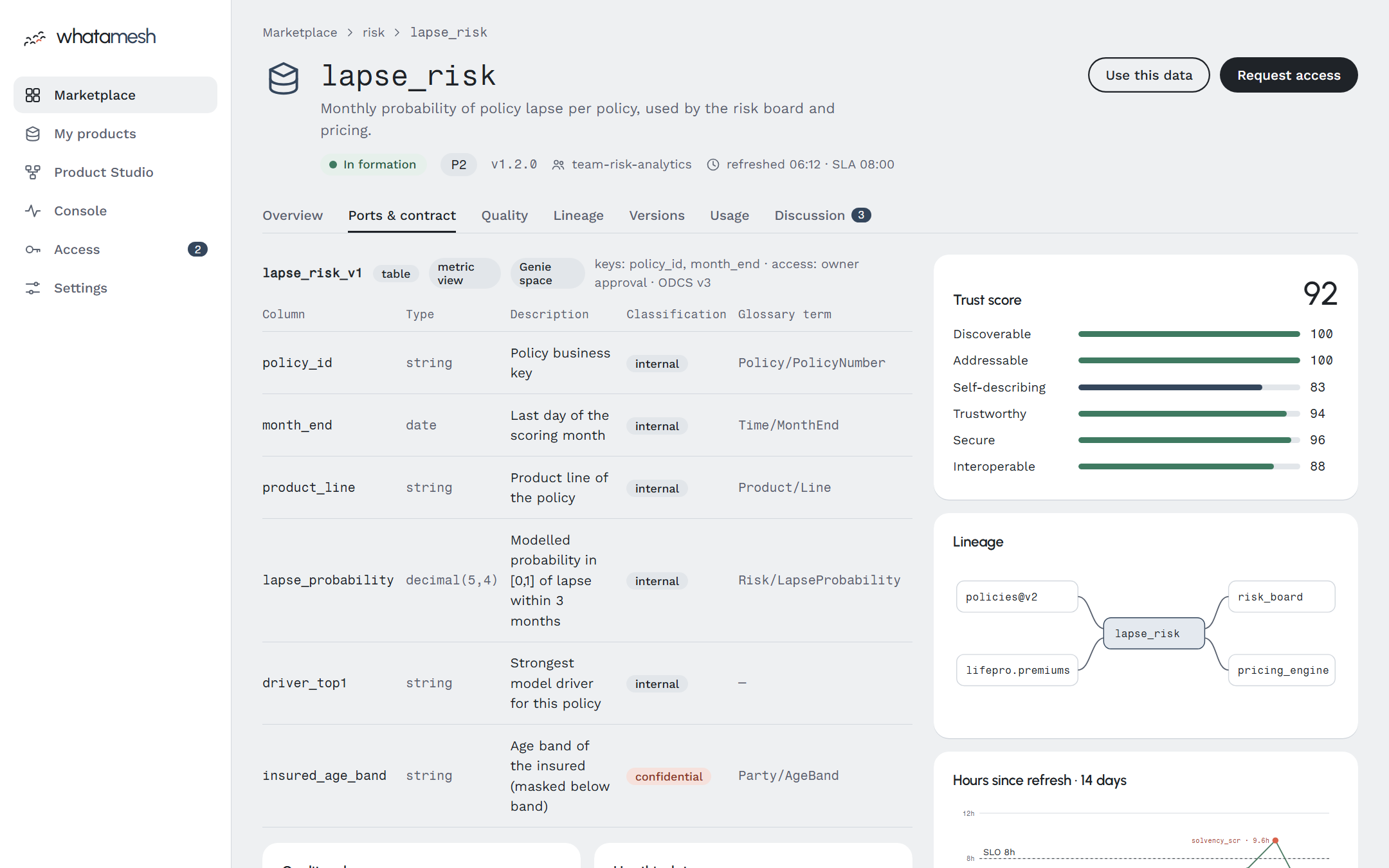
Every column gets a type, a description and checks. The national ID is classified and masked before anyone outside the team sees it. Together these make up contract v2.
What whatamesh does here
ODCS contracts
Policy packs in CI
PII classification and masking
Quality checks per tier
5 / 9 · release r14
Versioned, with proof of the change
A change is a pull request with a data diff: one probability moves from 0.12 to 0.14, and the gates confirm no consumer breaks. It ships as release r14.
What whatamesh does here
Pull request with a data diff
Gates 1–4 in your CI
Cycle detection across domains
Versioned ports
Shadow releases
0silent breaking changes: breaking means a new port version
1run manifest per run, pinning code and input versions
Freshness, SLOs and cost are tracked on every run. When the LifePRO load fails at 05:02, everything downstream joins one incident with one root cause instead of firing seven alerts, and the owner knows before the board does.
The same rows, now with a label: where they come from, who owns them, how fresh they are and what they promise. Another team can read the label and decide to use it without asking the owners.
Every domain builds its products the same way, and contracts connect them. Claims, pricing and finance each own theirs; lapse_risk is one node in the network they share.
For people who want to see a product before, or instead of, reading its YAML. Structure is a form, logic stays in SQL, and nothing built here is locked into the Studio.
12345
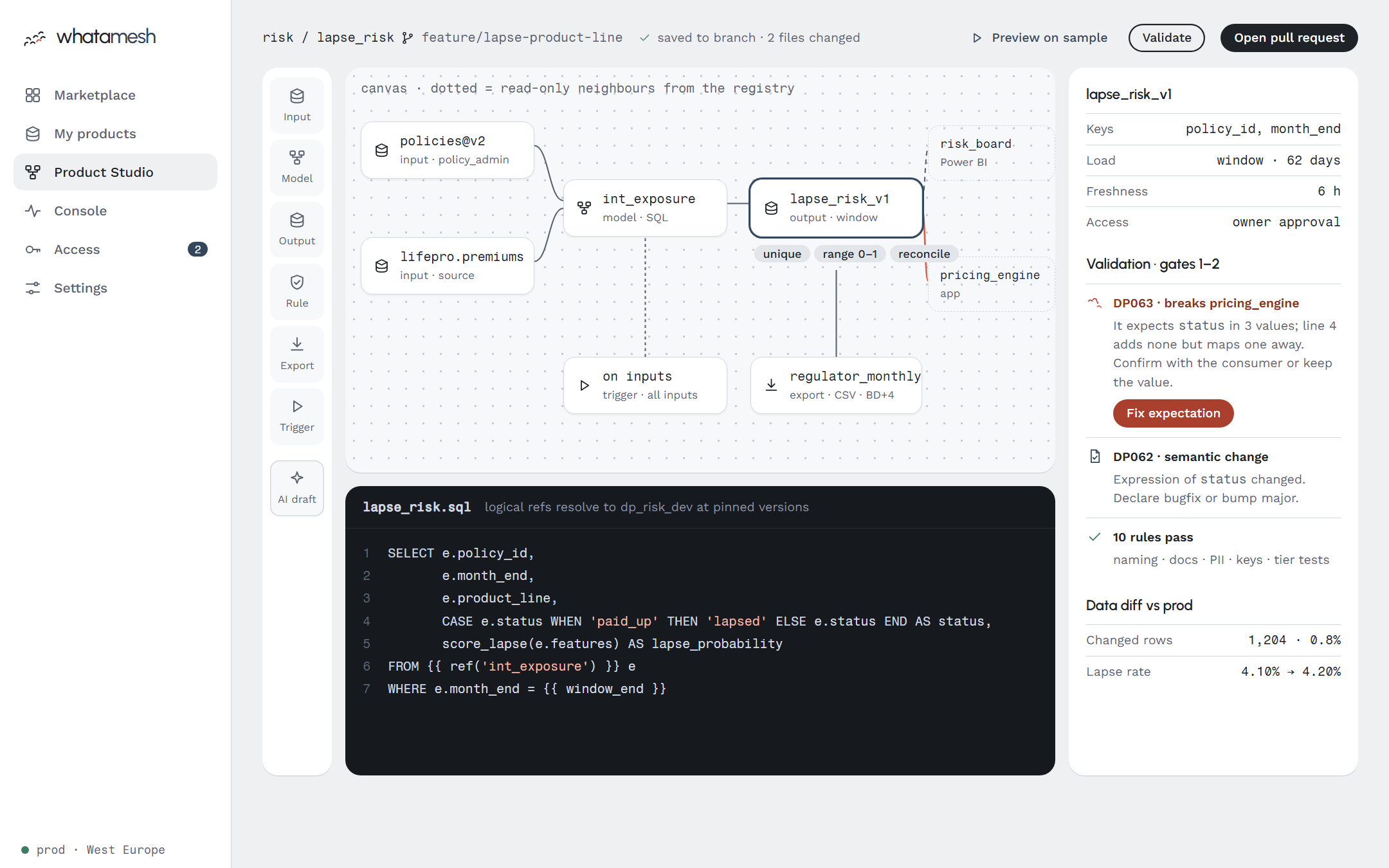
CanvasInputs, models, outputs, rules, exports and triggers as blocks. Neighbouring products from the registry sit alongside, read-only.
SQL for the logicEvery transformation is a SQL cell with logical refs and a preview on sample data. No visual join builder.
Gates beside the workRules run while you edit. Findings land on the block they concern, with the data diff on the output port.
Git underneathThe canvas reads and writes product.yaml and the SQL files. Saving makes a branch; shipping opens a pull request.
AI draftStart from sources and one sentence. The draft opens on the canvas for review, like any other change.
5 · release r14Git and CI/CD
From branch to production, through four gates
Every change, from the Studio, an editor or an AI draft, is a branch and a pull request in your own Git. The same gates run in your CI for every product, and the same release moves from test to prod.
DP063 · pricing_engine relies on status having 3 values. Add a mapping or agree a new expectation before merge.
6 · in useThe apps
The apps your teams use
Databricks Apps in your own workspace: a marketplace for the people who find and use data, a studio and console for the people who build and run it. Every screen reads with the viewer’s own Unity Catalog permissions.
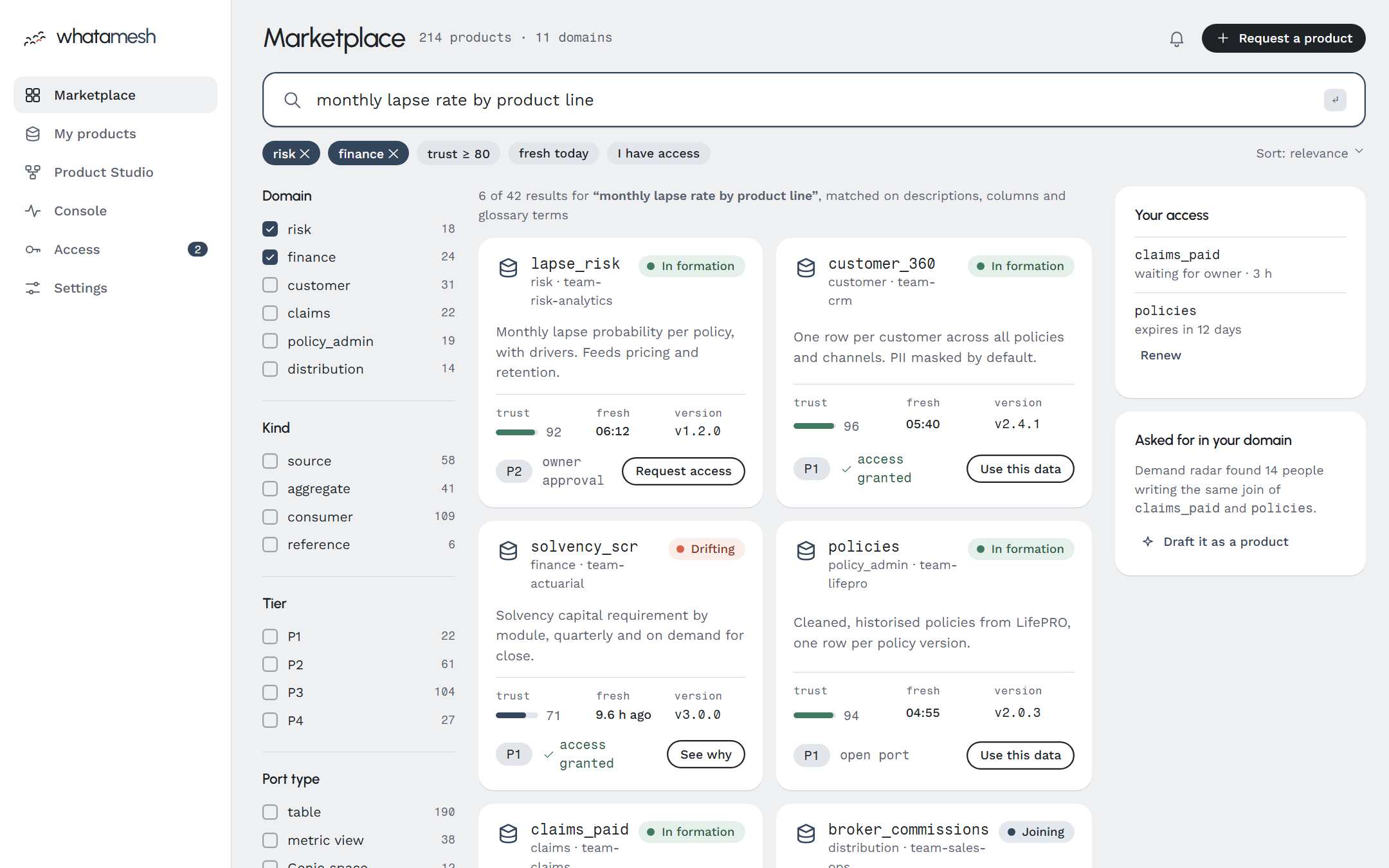
MarketplaceSearch in plain language, judge trust and freshness, request access in one step.
Product pagePorts, contract, classification and glossary terms, a trust score and lineage on one page.
6 · in useBeyond the warehouse
Wherever your data is used
Most data is read in Excel, Power BI, documents and dbt projects that lineage never sees. whatamesh brings each of them into the mesh as a known consumer or a governed product.
Excel, governed
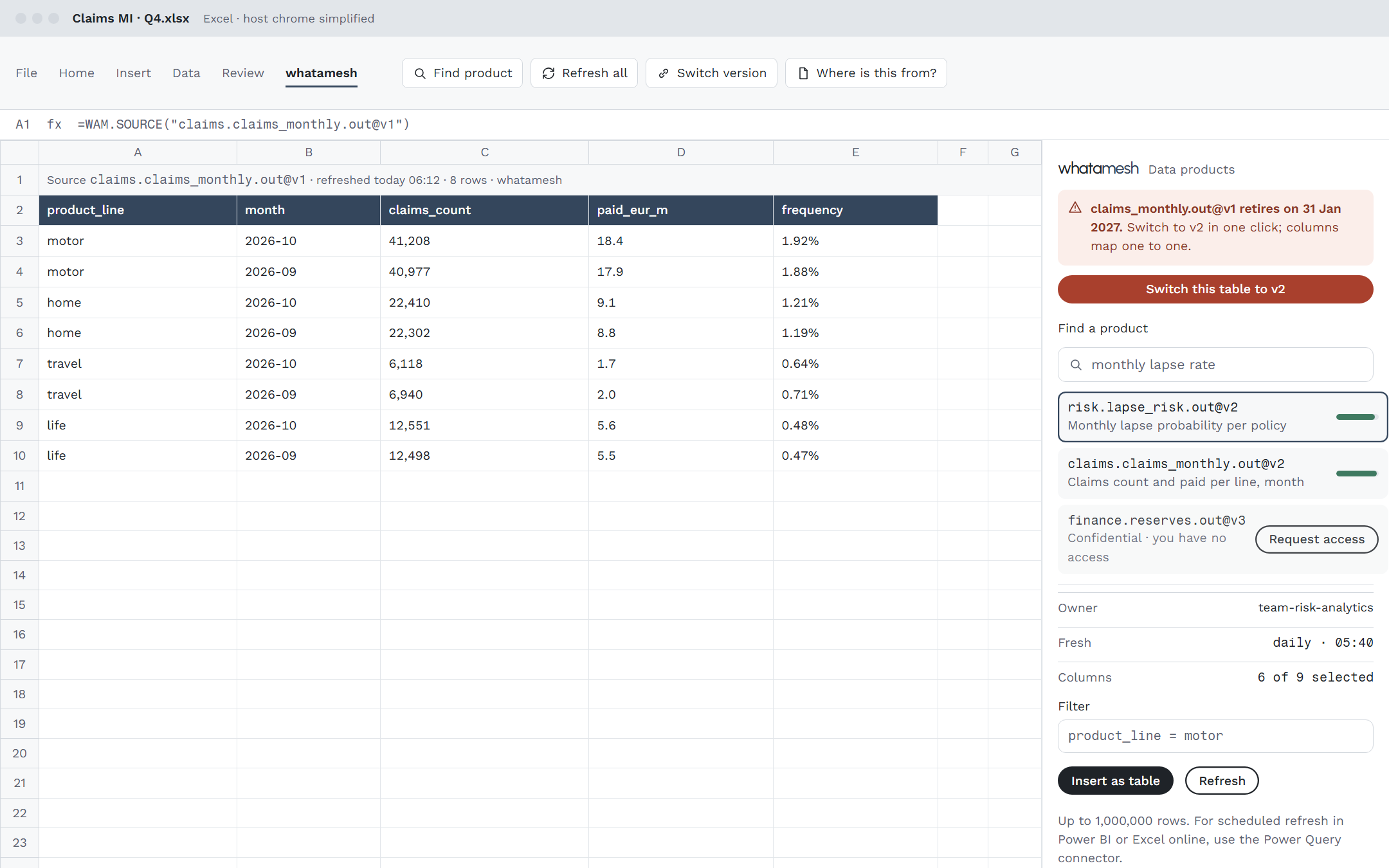
Insert a data product into a workbook with your own sign-in and refresh it in place. The workbook registers as a consumer, so a breaking change names it before merge.
Down to the Power BI report
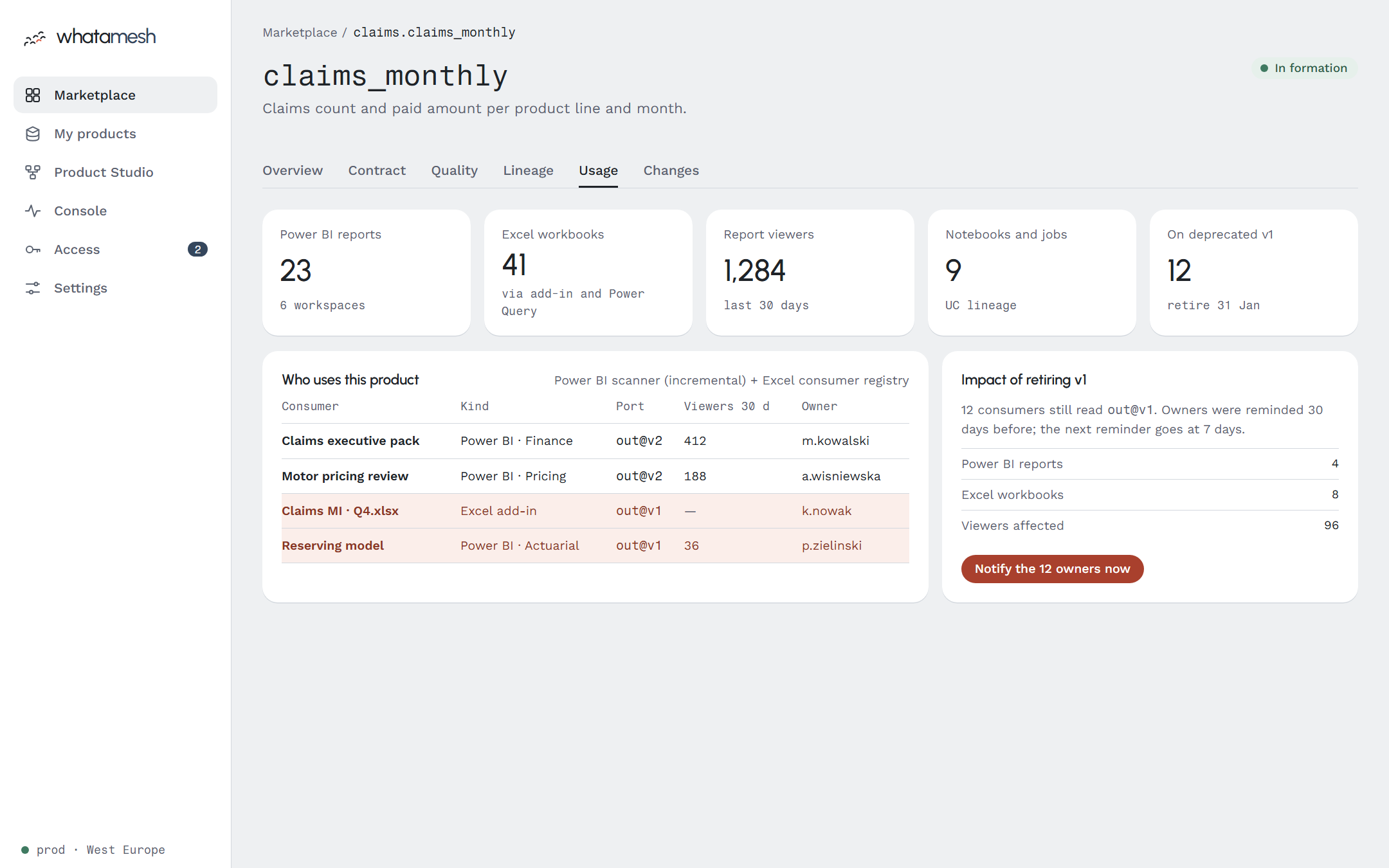
Report-level lineage and viewers from your Power BI tenant feed impact reports and the value ledger, so owners see the report the board reads.
Documents as products
Claims files and policy wordings become a document collection and a vector index, with PII redacted before indexing and row filters on every retrieval.
Bring your dbt project
Adopt dbt groups and public models as products with contracts and access workflow. dbt keeps building; breaking changes are caught the same way.
Excel add-inAnalysts find a product, insert it as a table and refresh it, with their own permissions and a provenance line.
Usage on the product pagePower BI reports and Excel workbooks appear as consumers, so owners see who a change affects before they make it.
01
Unity Catalog Discover
Domains, products and certification are published to Unity Catalog domains, so people find products where they already search.
02
Group federation
Subsidiaries implement group contracts and share them with head office over Delta Sharing, checked at the gate.
03
Agents on a budget
Every agent is registered, metered and budgeted, and rules stop an agent combining data its purpose does not allow.
6 · in useAI and agents
AI drafts. People approve.
The assistant drafts products, explains what failed and serves your data products to agents.
$ wam ai draft \
--sources lifepro.policies,lifepro.premiums \
--prompt "monthly lapse rate per product line"✓ reused policy_admin.policies@v2, no new input
✓ drafted YAML, SQL, docs, PII tags, 4 rules
✓ gates 1–2 pass · sample preview ready
→ pull request #231 for team-risk-analytics
assumptions the model made · paid-up policies count as in force · a month ends on its last calendar day
01
Runs in your tenant
Model calls go through your Databricks AI Gateway to the endpoints you choose, with your limits, your logs and your bill.
02
Metadata first
Schemas, profiles, lineage and contracts. Sample values only where your policy allows it; restricted columns never leave.
03
People approve
Every draft is a pull request that lists the assumptions the model made, and it passes the same gates as any change.
Draft a product
From sources and one sentence: YAML, SQL, column descriptions, classification, quality rules and a README, reusing products that already exist.
Explain and fix
Explains a failed rule in plain words, writes and explains queries in Studio cells, and suggests a fix when an incident opens.
Agents with your permissions
The MCP server gives agents search, contracts, validation and agent ports. Every call runs with the calling user's Unity Catalog permissions, and each agent is metered against its own budget.
Answers you can check
Each Genie space and agent port gets an evaluation set from its contract. Accuracy joins the trust score; a drop blocks promotion.
7 · runMesh Console
Run the mesh from one screen
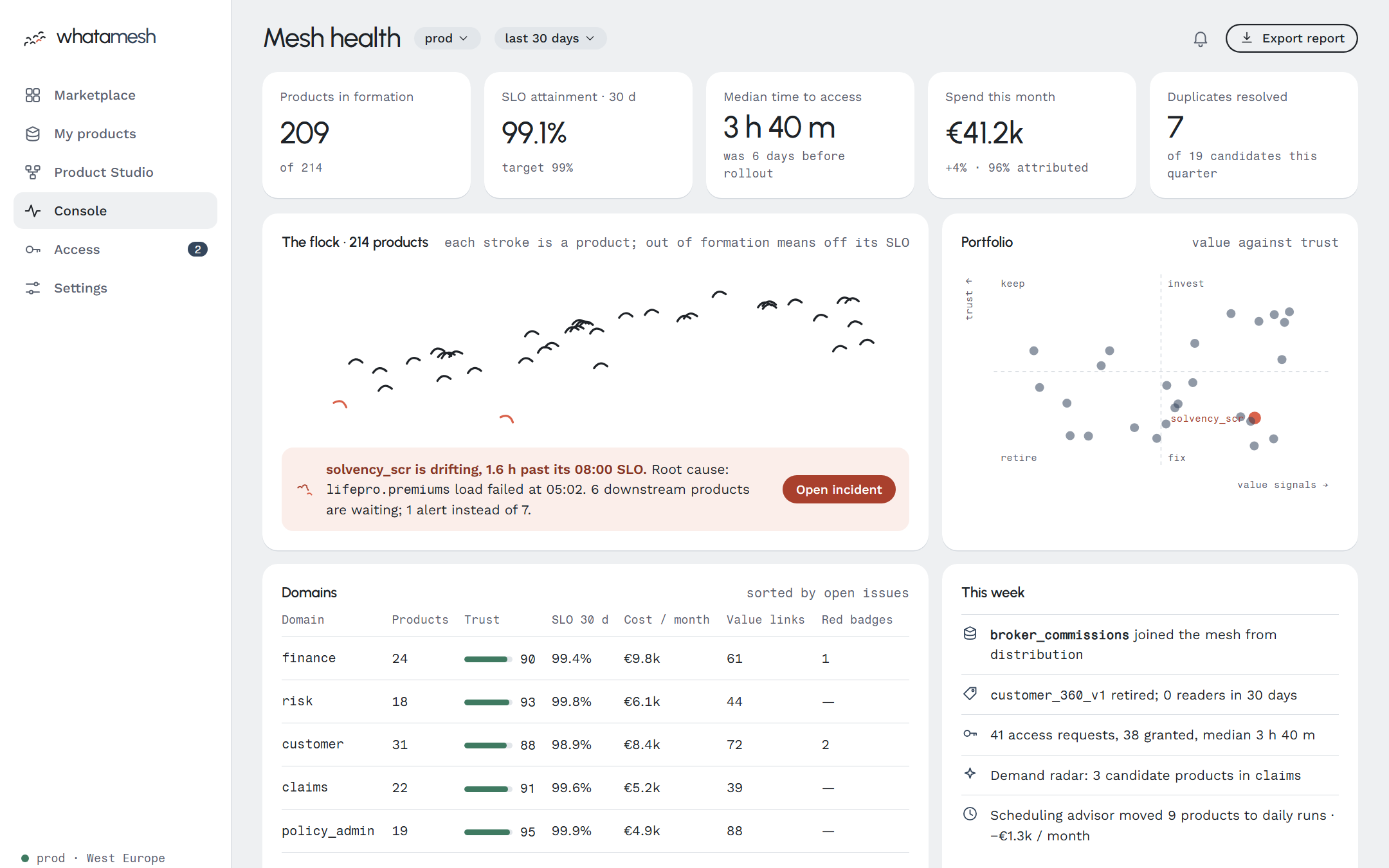
SLOs, incidents, trust, cost and value for every product, built from the lineage, usage and billing data your platform already records. Each product is a bird in the flock; out of formation means off its SLO.
solvency_scr is drifting, 1.6 h past its SLO. Root cause: lifepro.premiums load failed at 05:02. 6 downstream products waiting.
7 alerts1 incident
One incident per root cause
When an upstream load fails, every late product downstream joins one incident with the root cause, the owners and the consumers who are waiting.
Invest, keep, fix or retire
The value ledger links each product to the reports, models and decisions it feeds. Plotted against trust, it shows where the next sprint should go.
claims_reopened_monthly14 people · same join in 3 notebooks
broker_commission_rate9 people · still on legacy SQL Server
policy_holder_360overlaps customer_360_v2 · 82%
Cost and demand
Spend is attributed to each product and domain. The demand radar turns the queries people keep rewriting into candidate products, and duplicates are flagged with their overlap.
8 · data productRegulated pack
Evidence for the regulator, on demand
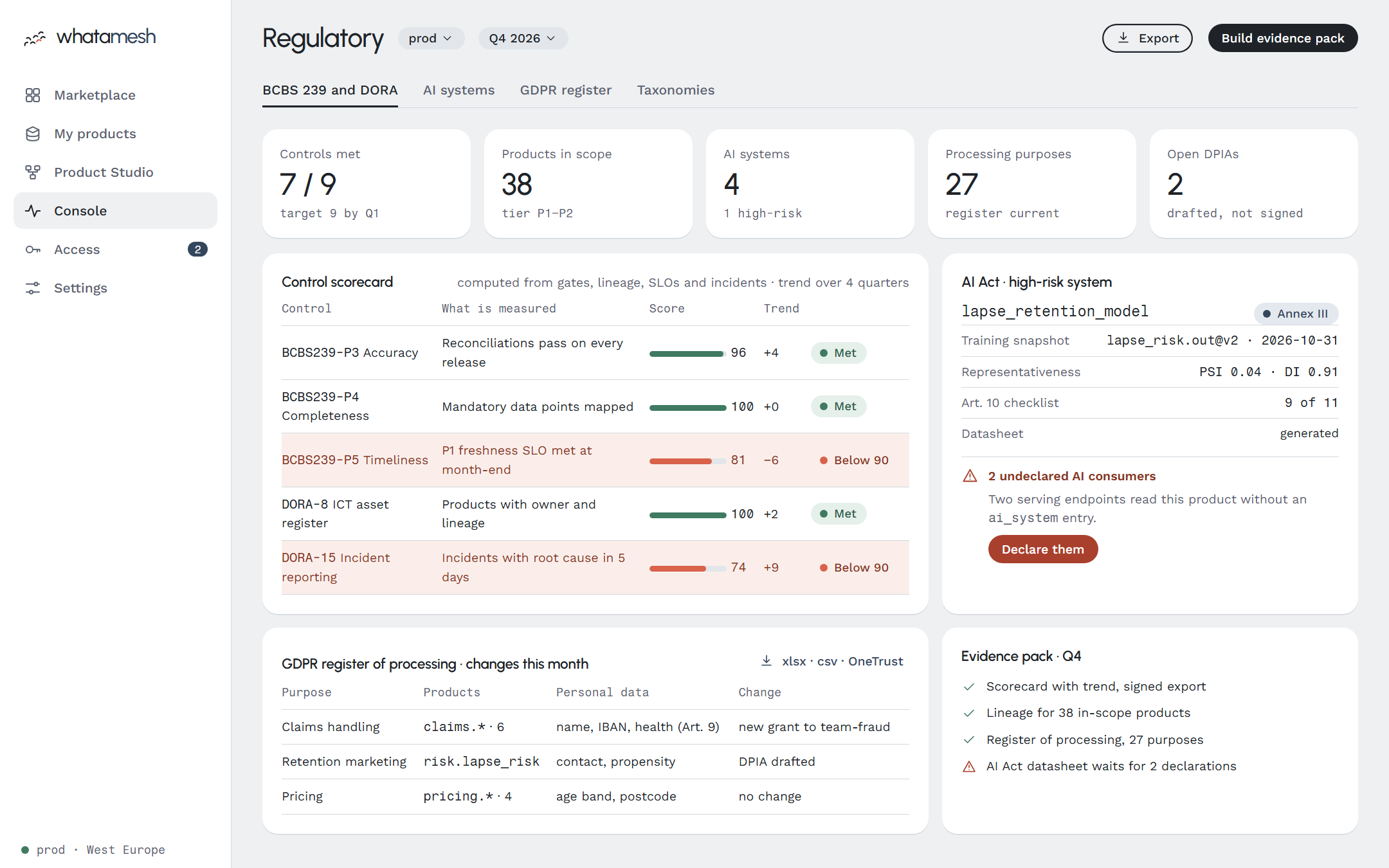
whatamesh already records lineage, run manifests, quality results, approvals and purposes for every product. The Regulated pack turns those records into the documents supervisors, auditors and your DPO ask for.
EU AI Act data governance
Dataset datasheets, representativeness and bias checks and pinned training snapshots for high-risk models such as life and health pricing.
GDPR records of processing
The Art. 30 register built from the purpose on every grant, the PII on every column and every recipient, with DPIA drafts for high-risk ports.
Regulatory ports
Ports mapped to Solvency II and FINREP/COREP data points, with the taxonomy validation rules run on every pull request instead of in the days before filing.
BCBS 239 and DORA
A self-assessment per principle and article from lineage, quality and change-control facts, each score linked to its evidence.
Evidence packs are generated in minutes, stored hashed in your Unity Catalog and mapped to Solvency II, IFRS 17, BCBS 239, DORA and the EU AI Act.
9 · the meshRules in the pipeline
Three rules, no leader
A murmuration turns as one because every bird follows the same three local rules. A data mesh can work the same way if its rules run in every pipeline, where a product that breaks them cannot ship.
Ownership
Each domain owns its catalog, its products and its releases, and nobody waits in a central ticket queue.
Serverless jobs · one per data productno always-on clusters · cost follows use
Unity Cataloggrants · tags · lineage · audit
Lakebase · AI Gatewaygovernance store · your models
Priced by the products you use
Domains and users are unlimited. The platform licence is banded by active data products, the unit governance already works in: each has an owner, a contract and its own access rules. Onboarding and migration are quoted for your estate. AI runs on your own Databricks bill.
An active product runs in production with a published contract and at least one consumer in the last 90 days; drafts and unused products cost nothing. Every engagement starts with a fixed-scope pilot on one domain, with our engineers inside your domain teams so the first products go live on a plan agreed for your estate. Buy through Azure or Databricks Marketplace against your existing commitment.
Start with one domain. Prove it on your own data first.
A fixed-scope pilot: our engineers sit with your domain team, so products go live fast and the skills stay. You keep everything we install.
$ wam assess --profile prod --days 90
✓ 4,812 tables · 38% without an owner
✓ 611 columns look like PII, untagged
✓ 22% of storage in likely duplicates
→ assess-report.html · business case inside
Before the pilot, a read-only scan of your Databricks estate shows ownership, PII, duplication and cost gaps in your own numbers. Nothing leaves your tenant.